
Measuring the Mind – The Future of Team Building in Sports
What if recruiting and coaching elite athletes wasn’t just about physical performance and match stats—but also about cognitive abilities and personality traits?
A new international study featured by Capacio confirmes and strengthens that elite football players excel in discipline, adaptability, quick thinking, and resilience—traits that can be measured and leveraged in talent scouting and team development.
This was exactly the topic of discussion in Sporthuset, where Lasse Granqvist, Tommy Åström, and Jens Fjellström explored how clubs can integrate psychological profiling into recruitment and coaching strategies.
🎧 Listen to the full discussion in Sporthuset:
Podcast Episode 488 – Fjellström’s Future Team
(Podcast is in swedish)
📖 Read more about the study and its implications for football scouting:
Capacio’s Study on Elite Football Players
#CognitiveScience #EliteAthletes #FootballInnovation #TalentScouting #SportsTech #Capacio

New International Study confirms that Elite Football Players are Disciplined, Quick Thinkers, Adaptable, and Resolute

New International Study Confirms That Elite Football Players Are Disciplined, Quick Thinkers, Adaptable, and Resolute
“What our study reveals is that elite football players exhibit remarkably higher cognitive abilities compared to the general population, especially in planning, working memory, and cognitive flexibility,” says Predrag Petrovic, co-founder of Capacio and associate professor at the Department of Clinical Neuroscience at Karolinska Institutet.
On January 14th, a comprehensive international study was published that further strengthens previous research findings about the cognitive abilities of elite football players. This is the most extensive study to date on the psychological profile of elite football players and is the result of close collaboration between universities in Oxford, Aarhus, Bologna, CQ University Australia, Rio de Janeiro State University, and Karolinska Institutet.
Predrag Petrovic, co-founder of Capacio, is an associate professor at the Department of Clinical Neuroscience at Karolinska Institutet and led the research study. The study analyzed the cognitive and psychological profiles of 204 elite football players from top teams in Brazil and Sweden, compared to 124 control subjects.

Predrag, Your First Study on Football Players Was in 2012. Why Did You Decide to Conduct Further Research?
This study is the first of its kind. Previous studies have been preliminary, whereas this is a full-scale, conclusive scientific study. It verifies our earlier insights and findings while exploring additional factors that were not previously tested.
The first study, conducted 12 years ago, identified significant behaviours among football players. However, it was criticized as being preliminary due to its limited sample size. Three to four years ago, we conducted another study to determine the behavioural factors behind an elite player’s success on the field. The results were once again confirmed, that study was also considered preliminary, as it included 50 elite football players.
This newly published study underscores the importance and strength of effective collaboration—not just on the football field but also within science. Normally, it’s incredibly difficult to gather a large enough group of elite football players to conduct a comprehensive study. This achievement was made possible thanks to my exceptional research colleague Alberto Filgueiras, a football psychologist in Brazil with expertise in football, psychology, and research. He was familiar with our previous study and proposed a joint research effort. By conducting the study across multiple countries, we managed to reach a sufficiently large group of elite football players for a complete analysis.
This scientific study is a testament to the power of collaboration driven by a shared passion for football.
What Does the New Study Contribute?
The cognitive results from the earlier studies are confirmed and in addition we can see that planning, working memory and cognitive flexibility are on high levels. This study also incorporates data from personality tests based on the Five-Factor Model, revealing significant similarities among elite players and differences compared to the control group. The study also demonstrates that elite football players’ abilities are universal—the Brazilian players display the same cognitive profile as the Swedish players. Finally, AI confirms the profile by pointing out the elite footballers from the control group.
What Are Your Hopes for the Impact of This Study?
Our football studies can be seen as a proof of concept for better understanding how humans function and how we can optimize our work based on our brain profiles. The research findings are not limited to football; rather, football serves as a context that enables us to conduct the research. Football is characterized by rapid shifts, stricter rules, and fewer degrees of freedom compared to everyday life. This creates ideal conditions for studying behavior.
In a broader context, the societal benefits could include:
- Gaining a deeper understanding of human functioning in various contexts.
- Identifying what can be done to optimize performance and well-being.
- Over time, contributing to a better-functioning society.
About the Study
The international study aimed to decode the psychological profiles of elite football players and was published on January 14th, 2024, in Proceedings of the National Academy of Sciences (PNAS). The research analyzed the cognitive and psychological profiles of 204 elite football players from top teams in Brazil and Sweden, compared to 124 control subjects. The research team utilized advanced tools and machine learning to uncover what makes these players unique. More information about the study can be found here.
Key Findings
- Cognitive Abilities: Elite football players exhibit remarkably higher cognitive abilities compared to the general population, particularly in planning, working memory, and cognitive flexibility.
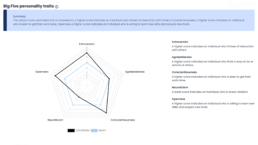
- Personality Traits: Players are more result-oriented, outgoing, and development-focused but show lower levels of emotional instability, anxiety, and agreeableness.
- Unique Profiles Confirmed by AI: Researchers, with the help of artificial intelligence, identified elite players with 97% accuracy solely based on their cognitive and psychological profiles.
- Confirmation of Previous Research: The study corroborates earlier findings on the importance of executive functions for success in football and offers new insights into the connection between cognition, personality, and performance.
Examples of Cognitive Findings
- Planning: Enables players to anticipate game patterns and make strategic decisions.
- Working Memory: Allows them to manage multiple streams of information simultaneously, such as opponents’ movements and teammates’ positions.
- Cognitive Flexibility: Facilitates rapid adaptation to changes on the field and decision-making under pressure.
Insights on Personality Traits
Research shows that elite football players exhibit:
- Lower Levels of Neuroticism:
- They are less prone to worry or stress, making them more stable in high-pressure situations such as decisive matches.
- This stability is crucial for handling the demands and stressful environments of elite football.
- Lower Levels of Agreeableness:
- They are less inclined to compromise and tend to be more competitive—a valuable trait on the field where determination and prioritizing team goals are essential.
- This doesn’t imply a lack of social skills but rather a focus on performance over avoiding conflict.
- Higher Levels of Extraversion:
- They are outgoing, energetic, and motivated to interact with others, which is beneficial in team environments and for maintaining strong communication on the field.
- Higher Levels of Conscientiousness:
- They are organized, disciplined, and reliable, which are crucial traits for training and performing at the highest level.
- Higher Levels of Openness to Experience:
- They are open to new ideas and methods, making them better equipped to learn, adapt, and grow in a dynamic sport environment.
Why Is This Important and Useful?
- Talent Identification:
- By understanding the combination of cognitive abilities and personality traits critical for football success, clubs can identify potential talents with the mental and social attributes to excel.
- Player Development:
- Different combinations of cognitive abilities and personality traits create varied player profiles. This insight allows for tailored coaching and support.
- Team Building and Performance Optimization:
- These findings enable the creation of teams where abilities and personalities complement each other, improving dynamics and results.
Ny Internationell Studie Bekräftar att Elitfotbollsspelare är Disciplinerade, Snabbtänkta, Förändringsbenägna och Kompromisslösa
”Det vi kan visa med studien är att elitfotbollsspelares kognitiva förmågor är anmärkningsvärt högre jämfört med normalpopulationen, särskilt inom planering, arbetsminne och kognitiv flexibilitet”, säger Predrag Petrovic, medgrundare till Capacio.
Den 14/1 publicerades en ny omfattande internationell studie som stärker de tidigare forskningsresultaten kring elitfotbollsspelares kognitiva förmågor. Studien är den hittills mest omfattande kring elitfotbollsspelares psykologiska profil och är ett resultat av ett nära samarbete mellan universiteten i Oxford, Aarhus, Bologna, CQ University Australia, Rio de Janeiro State University och Karolinska Institutet.
Capacios medgrundare Predrag Petrovic är docent vid institutionen för klinisk neurovetenskap, Karolinska Institutet och har lett forskningsstudien som har analyserat kognitiva och psykologiska profiler hos 204 elitfotbollsspelare från topplag i Brasilien och Sverige, jämfört med 124 kontrollpersoner.
Predrag, din första studie på fotbollsspelare kom redan 2012.Vad är bakgrunden till att ni ville genomföra ytterligare studier?
Denna studie är den första i sitt slag. Tidigare studier har varit preliminära, medan denna är en fullskalig, konklusiv studie. Den verifierar våra tidigare insikter och resultat och testar fler saker än innan.
Den första studien som kom för 12 år sedan visade på signifikanta beteenden hos fotbollsspelare men kunde kallas för preliminär baserat på begränsat antal spelare. För tre-fyra år sedan gjorde vi ytterligare en studie där vi ville ta reda på vilka beteendefaktorer som ligger bakom en elitspelares framgång på plan. Resultaten bekräftades återigen, men. även den studien var preliminär med 50 elitfotbollsspelare.
Den studie vi nu publicerar visar på vikten och kraften i ett bra samarbete, inte bara på fotbollsplanen utan även inom vetenskapen. Normalt sett så är det otroligt svårt att få tag i ett så stort antal elitfotbollsspelare så att det går att göra en komplett studie: Att detta kunde ske är tack vare min fantastiska forskningskollega Alberto Filgueiras som är fotbollspsykolog i Brasilien och kan fotboll, psykologi och forskning. Han kände till vår tidigare studie och kontaktade och föreslog en gemensam studie och genom att göra studien i flera länder kunde vi nå ut till en tillräckligt stor grupp av elitfotbollsspelare för en komplett studie.
Det som kan sägas är att studien är ett resultat av en hög vetenskaplig samarbetsvilja mellan olika lärosäten, forskningsdiscipliner och präglat av ett passionerat fotbollsintresse.
Vad tillför den nya studien?
Förutom att vi nu fått resultaten från de tidigare preliminära studierna bekräftade i en komplett studie så är det värdefullt visa att elitfotbollsspelares förmågor är globala – de brasilianska spelarna visar på samma kognitiva profil som de svenska.
Men denna studie har också kompletterats med forskningsdata i form av personlighetstester från Fem faktor-modellen och studien visar då signifikanta likheter mellan elitfotbollsspelarna samt olikheter mot kontrollgruppen.
Vad är din förhoppning att den nya studien ska leda till?
Min förhoppning är att det ger en kick till den här formen av forskning och att kunskapen om våra kognitiva förmågor och deras betydelse för vårt fungerande sprider sig i samhället och börjar användas.
Våra fotbollsstudier kan ses som ett Proof of Concept för att vi bättre ska förstå hur vi människor fungerar och hur vi optimerar vårt arbete utifrån vår hjärnprofil. Forskningsresultaten är inte begränsade till fotbollen utan här blir fotbollen ett sammanhang för att vi ska kunna genomföra forskningen. Fotbollen är snabbare i sina skiftningar, mer reglerat och med mindre frihetsgrader än vanliga livet. Härmed ges perfekta förutsättningar att studera beteende. I en större kontext så kan de samhälleliga vinsterna bli:
- Att bättre förstå människans fungerande i olika sammanhang.
- Att bättre förstå vad man kan göra för att man ska fungera optimalt och må bättre.
- På sikt ett bättre fungerande samhälle.
Om studien
Den internationella studien har haft som syfte att avkoda elitfotbollsspelares psykologiska profil och publicerades den 14/1 2024 i Proceedings of the National Academy of Sciences (PNAS). Studien har analyserat de kognitiva och psykologiska profilerna hos 204 elitfotbollsspelare från topplag i Brasilien och Sverige, jämfört med 124 kontrollpersoner. Till sin hjälp har forskningsteamet haft avancerade verktyg och maskininlärning för att avslöja vad som gör dessa spelare unika. Mer information om studien hittar du här.
Viktigaste insikterna
- Kognitiva förmågor: Jämfört med normalpopulationen så har elitfotbollsspelare anmärkningsvärt högre kognitiva förmågor, särskilt inom planering, arbetsminne och kognitiv flexibilitet.
- Personlighetsdrag: Spelarna visade sig vara mer resultatorienterade, utåtriktade och utvecklingsorienterade, men hade också lägre nivåer av emotionell instabilitet och oro samt vänlighet och tillmötesgående.
- Unika profiler som bekräftas av AI: Forskarna kunde med hjälp av artificiell intelligens identifiera elitspelare med 97 % träffsäkerhet enbart baserat på deras kognitiva och psykologiska profiler.
- Studien bekräftar tidigare preliminära forskningsresultat: Om vikten av exekutiva förmågor för framgång i fotboll och bidrar med nya insikter om sambandet mellan kognition, personlighet och prestation.
Exempel på kognitiva fynd
- Planering: Hjälper spelare att förutse spelmönster och fatta strategiska beslut.
- Arbetsminne: Möjliggör hantering av flera informationsflöden samtidigt, som motståndarnas rörelser och lagkamraters positioner.
- Kognitiv flexibilitet: Gör det möjligt att snabbt anpassa sig till förändringar på planen och fatta beslut under press.
Fynden i personlighetsdragen
Forskningen visar att elitfotbollsspelare hade:
- Lägre nivåer av neuroticism:
- De är mindre benägna att uppleva oro eller stress, vilket gör dem mer stabila under pressade situationer som avgörande matcher.
- Detta är viktigt för att hantera de höga krav och stressiga miljöer som fotboll på elitnivå innebär.
- Lägre nivåer av tillmötesgående:
- De är mindre benägna att kompromissa och kan vara mer tävlingsinriktade, vilket är en fördel på planen där beslutsamhet och förmågan att sätta egna och lagets mål först är avgörande.
- Detta innebär inte att de saknar social förmåga, men att de prioriterar prestation över att undvika konflikt.
- Högre nivåer av extraversion:
- De är mer utåtriktade, energiska och motiverade att interagera med andra, vilket är användbart i lagmiljöer och för att upprätthålla stark kommunikation på planen.
- Högre nivåer av samvetsgrannhet:
- De är organiserade, disciplinerade och pålitliga, vilket är avgörande för att kunna träna och prestera på toppnivå.
- Högre nivåer av öppenhet för nya erfarenheter:
De är öppna för nya idéer och metoder, vilket gör dem bättre rustade att lära sig, anpassa sig och utvecklas i en dynamisk sportmiljö.
Varför är detta viktigt och användbart?
- Talangidentifiering:
- Genom att förstå vilka kognitiva förmågor i kombination med personlighetsdrag som är viktiga för framgång i fotboll kan klubbar identifiera potentiella talanger som har både de mentala och sociala egenskaperna för att lyckas.
- Utveckling av spelare:
- Olika kombinationer av kognitiva förmågor och personlighetsdrag ger olika spelarprofiler. Med denna insikt kan coachingen och förutsättningar individanpassas.
- Lagbygge och optimering av prestation:
- Dessa insikter gör det möjligt att bygga lag där förmågor och personligheter kompletterar varandra, vilket kan förbättra dynamiken och resultaten.
Så skapade vi ett kognitivt lyft för Hammarby Handboll – ta del av metoder och resultat!
Hammarby handboll, kognitiva och exekutiva profiler
Innehåll
- Sammanfattning
- Om Capacio
- Handboll och hjärnan
- Forskning och evidens
- Objektiva och exakta mätverktyg som ger handlingsbara insikter och effekter
- Vad är det egentligen som mäts och varför
- Hur går det till
- Aktiviteter – Vad har gjorts med Hammarby
- Nytta och implementering av resultaten
- Fortsatta möjligheter Hammarby handboll och svensk handboll
Sammanfattning
Capacio har testat och profilerat Hammarby A och Hammarby juniorlag. Resultaten har återkopplats till Coach och sportchef samt till individuella spelare. Dels individuella profiler, dels lagprofil. Lagdelsanalys har genomförts på vissa spelare. Coach har tagit del av digitalt utbildningsmaterial. Workshops och dialog har hållits syftande till kunskapsöverföring och gemensamt lärande kring den kognitiva handbollsprofilen. Genomförda aktiviteter, tillvägagångssätt och resultat delas i denna rapport.
Om Capacio
Capacio är medgrundat av ledande hjärnforskare och beteendevetare och kombinerar djup kunskap om hjärna, beteende med modern teknik såsom AI. Man har utvecklat en digital plattform och erbjuder tjänster för att mäta, tolka och utveckla och optimera fungerande, prestation och mående.
Handboll och hjärnan – Relevans
Handboll är en sport där förmågan att under ständig press, snabbt och korrekt anpassa sig till förändringar, fatta beslut och lösa problem är avgörande för framgång. Det är hjärnans s.k. exekutiva funktioner, ett antal medfödda förmågor som avgör hur denna process fungerar.
Forskning och evidens
Mätning och förståelse för dessa förmågor och processer är nu fullt möjligt tack vare över 100 års hjärnforskning (neurovetenskap) med djup kunskap om hjärnans fysiologi och struktur i kombination med fotografering (hjärnavbildning) och beteendeexperiment. Mätverktygen har härifrån kunnat överföras till papper och penna under ledning av specialutbildade psykologer (neuropsykologer) och nu slutligen digitalt på mobiltelefon. Testerna innebär att stickprov tas på styrkan hos de olika exekutiva förmågorna.
Objektiva och exakta mätverktyg som ger handlingsbara insikter och effekter
Tilliten till resultaten kräver objektiva och exakta mätverktyg där resultaten kan omtolkas till handlingsbara insatser som ger upplevd- och mätbar effekt. En viktig del i tolkningen av resultaten är att kunna jämföra och relatera resultaten. Utöver jämförelsen med andra specifika spelare är den s.k. normen viktig. En norm är en generell jämförelseprofil som är statistiskt säkerställd. Testerna är grunden noggrant validerade av hjärnforskare och beteendevetare (att de mäter det de ska) och normerade mot världsbefolkningen. Tillsammans med erfarna och kunniga handbollsexperter har även validerats att testerna stämmer ur både coach- och spelarperspektivet, s.k. ”face validity”. Detta innebär att varje test av varje förmåga kan jämföras mot genomsnittsbefolkningen, rensat för åldersskillnader. Och att genom att samla in tillräckligt med data kan man också skapa en specifik handbollsnorm eller profil och även positionsprofiler.
Vad är det egentligen som mäts och varför
Förmågorna styr och reglerar övriga hjärna och även mänskligt beteende och utförandeförmåga. Man mäter den kognitiva kapaciteten för att kunna bedöma utförandeförmågan i olika miljöer, situationer, uppgifter och positioner. Härigenom kan man få en djupare förståelse för individers och lags styrkor och svagheter och härmed förbättra hela talangprocessen från urval, matchning, till utveckling, coachning och träning av individ, ledare och team. Förmågorna som mäts är
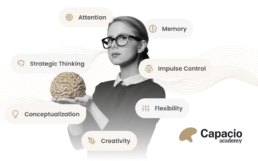
- Grundläggande uppmärksamhet – Att kunna koncentreras sig och fokusera på en uppgift.
- Kontrollerad uppmärksamhet – Förmågan att medvetet styra och fokusera sin uppmärksamhet på en ny stimulus eller uppgift, särskilt när något oväntat händer eller när distraktioner finns.
- Korttidsminne – Att uppfatta och registrera det som hände här och nu
- Arbetsminne – Att hålla ny och gammal information aktuell, ”online” och jobba med den när man analyserar, fattar beslut och löser problem.
- Impulskontroll – Att reglera sina impulser och infall. ”Gas och broms”. Stark koppling till ”tajming” på planen.
- Kognitiv flexibilitet – Förmågan att växla mellan olika tankesätt, perspektiv, eller uppgifter. Att snabbt kunna anpassa sig till nya regler, uppgifter eller miljöer utan att fastna i tidigare tankemönster.
- Kreativitet – Att hitta nya, unika lösningar på olika problem och utmaningar som dyker upp.
- Konceptualisering – Förmågan att kunna identifiera, organisera och förstå övergripande koncept eller regler som kopplar samman olika objekt, idéer eller uppgifter. Detta kräver att individen kan se samband och abstrakta likheter, vilket är avgörande för komplex problemlösning, planering och anpassning till nya situationer.
- Strategiskt tänkande – Förmågan att hitta den mest effektiva vägen till ett givet mål.
Hur går det till
Bakgrunden och kunskapen är komplex men tillämpningen enkel.
- Definiera syfte, mål och omfattning med testningen
- Med utvalda nyckelpersoner och spelare om så definierats
- Genomför testning. 45 min per spelare enligt instruktion och under optimala förutsättningar för maximal kvalitet i ”baslinjeprofilen”.
- Individuell profilering. Sker automatiskt med en generell standardrapport. Baslinje. Ev. omtestning vid avvikande resultat eller problem vid testtillfället.
- Lagets gemensamma styrkor och svagheter
- Lagdelsprofilering och samspelsanalys
- Eventuell skapande av handbolls och positionsprofil
- Analys, tolkning och översättning till handbollstermer
- Återkoppling av testresultat
- Insatsplanering och insatser
- Uppföljning av effekt
- Fortlöpande utbildning, testning, tolkning, insatser och stöd
Aktiviteter – Vad har gjorts tillsammans med Hammarby handboll
| # | Aktivitet | Innehåll | Utfall |
| 1 | Syfte, mål, omfattning | Profilera A-lag och akademi. | Klart |
| 2 | Introduktionsutbildning | Främst Coach. Även till del sportchef och spelare. | Klart |
| 3 | Testning | Varje individuell spelare gör testet. | Klart |
| 4 | Individuell profilering | Se ovan. | Klart |
| 5 | Teamprofil | Se ovan. | Klart |
| 6 | Lagdelsprofiler och samspelsanalys | Påbörjad och återkopplad på mycket hög nivå. Fördjupning på gång. | Pågår |
| 7 | Handbollsprofil | Del i samverkan med andra lag. Data insamlat för första datadriven profil. Strax framtagen. | Pågår |
| 8 | Analys, tolkning och översättning till handbollsmiljön | Pågått parallellt med annat lag och coach. Kunskapsöverföring påbörjas. Påbörjad djupdykning i ett antal ”specialfall” för ökad förståelse och maximal tillämpning och nytta. | Klart Pågår |
| 9 | Återkoppling av testresultat | A-laget återkopplat till spelare, coach och sportchef. Spelare har fått rapport och digitala tolkningsresurser. Även återkoppling i grupp inklusive frågestund och dialog. Samma sak för teamprofil. Akademi ska genomföras individuell återkoppling på liknande sätt. Lagdels och samspelsanalys påbörjad och pågår. Kunskapsöverföring påbörjad från det parallella projektet. | Klart Pågår |
| 10 | Insatsplanering och insatser | Utanför uppdraget men viktig och önskvärd. Några lågt hängande frukter har identifierats och adresserats. | Påbörjat |
Nytta och implementering av resultaten
Insikterna som uppnås kan användas för att stärka spelare och lag inom en rad områden.
| Nytta | Beskrivning | Hammarby handboll |
| Nya insikter och verktyg | Förståelse för hjärnans informationsbearbetning och hur det kopplar till spel och utförande på planen ger konkurrensfördelar och beslutsunderlag. | JA |
| Minskad subjektivitet och partiskhet | Objektiva data minskar bias vid talangidentifiering och laguttagning. | JA |
| Ökad förståelse för Individuellt fungerande | Anpassade stödinsatser utifrån varje spelares kognitiva profil, variation och olika kontexter. | Ökad förståelse. Vissa insatser. Fortsätter i nästa steg. |
| Individanpassad coaching | Träningsprogram utformade efter styrkor och svagheter. | ” |
| Tids- och Effektivitet | Snabb anpassning av träning baserat på kognitiva profiler. | Nästa steg. |
| Stärkta relationer | Underlaget ger ledare och spelare, snabbt och precist underlag för relevanta och personliga dialoger som annars inte skulle inträffa eller ta lång tid och som ger stärkt insikt om sig själv och andra. | Påbörjat. Fortsätter i nästa steg. |
| Ökad förståelse för spelintelligens | Utvecklad förståelse för- och utveckling av speluppfattning och spelintelligens hos individer och lag. | Ja. Se bilaga. |
| Stärkt talangidentifiering och utveckling: | Se fler delar av spelares potential, styrka och svagheter och härmed bättre kunna coacha, träna och matcha. | Ja. Akademi. Inlånad spelare mm. |
| Taktisk anpassning | Justera taktik baserat på kognitiva profiler. | Ja påbörjad. Fortsätter i nästa steg. |
| Strategisk lagkomposition | Formera lag med kompletterande kognitiva styrkor. | I detta steg, insikt om lag oh lagdelars profiler och matchning. I nästa steg kan tas vidare. |
| Matchning av spelare | Para ihop spelare med kompatibla profiler. Och/eller coacha spelare till ökad kompatibilitet i utförandet baserat på faktiska kognitiva styrkor och svagheter. | ” |
| Teamdynamik och Samspel | Förbättra teamwork och kommunikation, baserat på ökad, tillförlitlig insikt om fungerande, prestation och mående. | Insikt vunnen på hög nivå. Återstår att ta det vidare individuellt och lagmässigt. Kan ske i nästa steg. |
| Stressresiliens och Välbefinnande: | Stöd för mental hälsa och hantering av stress. | Djupare och optimerande insatser i två konkreta fall där stress och känsloreglering haft negativ inverkan på spelare/spelet. |
| Skadeprevention och Bedömning: | Skadeförebyggande insatser och träning samt rehabiliteringsstöd utifrån kognitiva styrkor, svagheter och skaderisker eller | Nästa steg
|
| Ledarutveckling | Ledare kan själva ta tester och använda insikterna för att stärka samverkan och individanpassa sin coachning och kommunikation utifrån egna och spelares förutsättningar. | Nästa steg |
Fortsatt utveckling
I ovanstående tabell framgår möjligheter, tillämpningar och nytta. Slutliga effektmål kan konkretiseras och kvantifieras inom såväl funktion, prestation, samspel, mående. Förslag på fortsatta konkreta aktiviteter och insatser som skulle gagna svensk handboll
- Fortsättningsuppdrag med Hammarby som svensk pilotklubb. Ta ned resultaten på konkret nivå och integrera i löpande coachning och träning. (Separat förslag kan lämnas).
- Upprepad testning för att fastslå baslinje, min, max (variation). Hitta fler nyanser
- Komplettera kognitiva profilen med personality ++, forskningsbaserade frågeformulär som fångar personlighet, känsloreglering mm och kompletterar den kognitiva profilen och ger en koppling mellan spelares subjektiva beskrivning
- 360 analys. Coach och andra skattar spelarens personlighet, förmågor och spelförmåga. Ytterligare stärka underlaget och hitta förbättringspotential på individ, lag och lagdelsnivå
- Korrelera psykologiska data med statistik, tränings och fysdata
- Skapa en starkare datadriven handbollsprofil genom att stärka datainsamlingen, exempelvis testa samtliga spelare i svenska ligan och i landslaget.
- Med stärkt datainsamling, skapa positionsprofiler, identifiera fler exempel, skapa exempelbank att lära ifrån
- Stärka översättningen från kognitiv kapacitet och utförandeförmåga till handboll.
Bilagor
- PDF, one-pager.
- PPT, övergripande beskrivning av Capacio verktyg, bakgrund, tillämpning.
- Whitepaper om kognition och spelintelligens/speluppfattning i sport (Länk i sista bild i 2.PPT). Publicerad i samband med Linhac.
- Kognitiv handbollsprofil (4 lag, 75 spelare).
- Hammarby handboll, kognitiv profil (Individ, Lag, Lagdel, Exempel på utmaningar och insatser).
Hammarby handball, cognitive and executive profiles
Contents
- Executive summary
- About Capacio
- Handball and the brain
- Research and evidence
- Objective and accurate measurement tools that provide actionable insights and impacts
- What is actually being measured and why
- How does it work
- Activities – What has been done with Hammarby
- Usefulness and implementation of the results
- Continued opportunities for Hammarby handball and Swedish handball
Executive summary
Capacio has tested and profiled Hammarby A and Hammarby junior team. The results have been fed back to the Coach and Sports Director and to individual players. Partly individual profiles, partly team profile. Team part analysis has been carried out on some players. Coach has taken part in digital training material. Workshops and dialog have been held with the aim of knowledge transfer and joint learning around the cognitive handball profile. Implemented activities, approaches and results are shared in this report.
About Capacio
Capacio is co-founded by leading brain and behavioral scientists and combines deep knowledge of brain and behavior with modern technologies such as AI. It has developed a digital platform and offers services to measure, interpret and develop and optimize functioning, performance and well-being.
Handball and the brain – Relevance
Handball is a sport where the ability to adapt to change, make decisions and solve problems quickly and correctly under constant pressure is crucial for success. It is the brain’s so-called executive functions, a set of innate abilities that determine how this process works.
Research and evidence
Measuring and understanding these abilities and processes is now fully possible thanks to over 100 years of brain research (neuroscience) with deep knowledge of brain physiology and structure combined with photography (brain imaging) and behavioral experiments. From here, the measurement tools have been transferred to paper and pencil under the guidance of specially trained psychologists (neuropsychologists) and now finally digitally on mobile phones. The tests involve sampling the strength of the different executive abilities.
Objective and accurate measurement tools that provide actionable insights and impacts
Confidence in results requires objective and accurate measurement tools where results can be translated into actionable interventions that have a perceived and measurable impact. An important part of interpreting results is being able to compare and relate results. In addition to the comparison with other specific players, the so-called norm is important. A norm is a general comparison profile that is statistically valid. The tests are thoroughly validated by neuroscientists and behavioral scientists (that they measure what they should) and normed against the world population. Together with experienced and knowledgeable handball experts, it has also been validated that the tests are correct from both the coach and player perspective, so-called “face validity”. This means that each test of each ability can be compared against the average population, adjusted for age differences. And that by collecting enough data, one can also create a specific handball norm or profile and also position profiles.
What is actually being measured and why
These abilities control and regulate the rest of the brain and also human behavior and performance. Cognitive capacity is measured to assess performance in different environments, situations, tasks and positions. This allows a deeper understanding of the strengths and weaknesses of individuals and teams, thus improving the entire talent process from selection, matching, to development, coaching and training of individuals, leaders and teams. The abilities measured are
- Basic attention – Being able to concentrate and focus on a task.
- Controlled attention – The ability to consciously direct and focus one’s attention on a new stimulus or task, especially when something unexpected happens or when distractions are present.
- Short-term memory – perceiving and recording what happened in the here and now
- Working memory – Keeping new and old information up to date, ‘online’ and working with it when analyzing, making decisions and solving problems.
- Impulse control – regulating your impulses and whims. “Gas and brake”. Strong link to ‘timing’ on the pitch.
- Cognitive flexibility – The ability to switch between different mindsets, perspectives, or tasks. Being able to adapt quickly to new rules, tasks or environments without getting stuck in previous thinking patterns.
- Creativity – Finding new, unique solutions to different problems and challenges that arise.
- Conceptualization – The ability to identify, organize, and understand overarching concepts or rules that link different objects, ideas, or tasks. This requires the individual to see connections and abstract similarities, which is essential for complex problem solving, planning and adapting to new situations.
- Strategic thinking – The ability to find the most effective path to a given goal.
How does it work
The background and knowledge is complex but the application is simple.
- Define the purpose, objectives and scope of the testing
- Induction training. With selected key persons and players if defined
- Conduct testing. 45 min per player as instructed and under optimal conditions for maximum quality in the “baseline profile”.
- Individual profiling. Automatically done with a general standard report. Baseline. Possible retesting in case of anomalous results or problems at the time of testing.
- Team profiling. Common strengths and weaknesses of the team
- Component profiling and interaction analysis
- Handball profile. Possible creation of handball and position profile
- Analysis, interpretation and translation into handball terms
- Feedback on test results
- Contingency planning and operations
- Monitoring of impact
- Ongoing training, testing, interpretation, interventions and support
Activities – What has been done together with Hammarby Handball
| # | Activity | Contents | Outcome |
| 1 | Purpose, objectives, scope | Raise the profile of A teams and academies. | Clear |
| 2 | Induction training | Mainly Coach. Also partly sports manager and player. | Clear |
| 3 | Testing | Each individual player takes the test. | Clear |
| 4 | Individual profiling | See above. | Clear |
| 5 | Team profile | See above. | Clear |
| 6 | Component profiles and interaction analysis | Started and feedback at very high level. Deepening underway. | Ongoing |
| 7 | Handball profile | Part in collaboration with other teams. Data collected for first data-driven profile. Soon to be developed. | Ongoing |
| 8 | Analysis, interpretation and translation to the handball environment | Ongoing in parallel with other team and coach. Knowledge transfer is starting. Started a deep dive into a number of “special cases” for better understanding and maximum application and benefit. | Done In progress |
| 9 | Feedback on test results | First team feedback to players, coach and sports director. Players have received reports and digital interpretation resources. Also feedback in groups including question time and dialog. Same for team profile. Academy should be conducted individual feedback in a similar way. Team part and interaction analysis started and ongoing. Knowledge transfer started from the parallel project. | Clear Ongoing |
| 10 | Contingency planning and operations | Out of scope but important and desirable. Some low hanging fruits have been identified and addressed. | In progress |
Usefulness and implementation of the results
The insights gained can be used to strengthen players and teams in a range of areas.
| Benefit | Description of the project | Hammarby handball |
| New insights and tools | Understanding the brain’s information processing and how it relates to play and performance on the field provides competitive advantage and decision support. | YES |
| Reduced subjectivity and bias | Objective data reduces bias in talent identification and team selection. | YES |
| Increased understanding of individual functioning | Customized support interventions based on each player’s cognitive profile, variety and different contexts. | Increased understanding. Some action. To be continued in the next step. |
| Personalized coaching | Training programs designed according to strengths and weaknesses. | “ |
| Time and efficiency | Rapid adaptation of training based on cognitive profiles. | Next steps. |
| Strengthening relationships | It provides leaders and players with a quick and accurate basis for relevant and personal dialogues that would otherwise not occur or take a long time and that provide stronger insight into oneself and others. | Started. To be continued in the next step. |
| Increased understanding of game intelligence | Developed understanding and development of game perception and game intelligence in individuals and teams. | Yes. See annex. |
| Strengthening talent identification and development: | See more parts of a player’s potential, strengths and weaknesses and thus be able to better coach, train and match. | Yes. Academy. Loaned player etc. |
| Tactical adaptation | Adjust tactics based on cognitive profiles. | Yes started. Continuing in the next step. |
| Strategic team composition | Form teams with complementary cognitive strengths. | In this step, insight into team and team part profiles and matching. In the next step can be taken further. |
| Matching of players | Pairing players with compatible profiles. And/or coach players to increased compatibility in performance based on actual cognitive strengths and weaknesses. | “ |
| Team dynamics and interaction | Improve teamwork and communication, based on increased, reliable insight into functioning, performance and well-being. | Insight gained at a high level. Remains to take it further individually and team-wise. Can be done in the next step. |
| Stress Resilience and Wellbeing: | Support for mental health and stress management. | Deeper and optimizing interventions in two concrete cases where stress and emotion regulation had a negative impact on players/game. |
| Injury Prevention and Assessment: | Injury prevention and training and rehabilitation support based on cognitive strengths, weaknesses and injury risks or | Next step
|
| Leadership development | Leaders can take tests themselves and use the insights to strengthen collaboration and individualize their coaching and communication based on their own and players’ conditions. | Next step |
Continued development
The above table shows opportunities, applications and benefits. Final effect goals can be concretized and quantified in function, performance, interaction and well-being. Suggestions for further concrete activities and initiatives that would benefit Swedish handball
- Continuation mission with Hammarby as Swedish pilot club. Bring the results down to a concrete level and integrate into ongoing coaching and training (separate proposal can be made).
- Repeated testing to establish baseline, min, max (variation). Find more nuances
- Complement the cognitive profile with personality++, research-based questionnaires that capture personality, emotion regulation, etc. and complement the cognitive profile, providing a link between players’ subjective description
- 360 analysis. Coach and others assess the player’s personality, abilities and playing skills. Further strengthen the foundation and find potential for improvement at individual, team and sub-team level
- Correlate psychological data with statistics, training and physical data
- Create a stronger data-driven handball profile by strengthening data collection, e.g. testing all players in the Swedish league and in the national team.
- With strengthened data collection, create position profiles, identify more examples, create example bank to learn from
- Strengthen the translation from cognitive and performance skills to handball.
Appendices
- PDF, one-pager.
- PPT, overall description of Capacio tools, background, application.
- Whitepaper on cognition and game intelligence/game perception in sport (Link in last slide of 2.PPT). Published in conjunction with Linhac.
- Cognitive handball profile (4 teams, 75 players).
- Hammarby handball, cognitive profile (Individual, Team, Team part, Examples of challenges and interventions).

Staffan Olsson Aims to Revolutionize Team Performance with Capacio's Groundbreaking Executive Functioning Tests
In the fiercely competitive realm of sports, marginal gains often determine victory. While physical prowess has its limits, the exploration of cognitive potential remains a relatively untapped frontier. Capacio, a pioneer in cognitive assessments, is at the forefront of harnessing neurocognitive analytics to enhance team performance.
Co-founded by Associate Professor Predrag Petrovic, Capacio first made headlines in 2010 with a seminal research study in football, demonstrating the ability to predict player performance with high accuracy based on neurocognitive assessments. Notably, the research shifted focus from disabilities to the ability and “successful functioning” of individuals, offering a new perspective on cognitive potential.
Today, Capacio has conducted over 5,000 analyses and developed a digital test accessible via smartphones. These tests can predict not only individual behaviors but also the dynamics of group functionality—crucial in both the corporate and sports sectors.
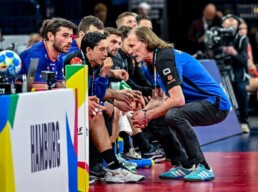
A significant advocate of Capacio’s methodologies is Staffan Olsson, former handball star and current coach of the Dutch national team. Ahead of the 2024 European Championship in Germany, Staffan partnered with Capacio to administer neurocognitive tests to his team, aiming to optimize each player’s role within the squad. Although the championship’s results didn’t fully meet their expectations, significant improvements in individual player integration and team dynamics were evident. Recently he and the team managed to qualify to the world championship 2025, quite an achievement for a small handball nation.
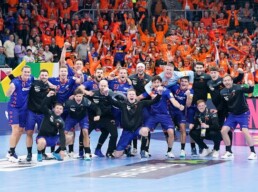
Staffan Olsson’s initiative marks a pioneering move in handball, inspired by his previous successes with Capacio’s technology in football. “The physical limits are almost maxed out in sports today, but the brain remains largely unexplored,” says Staffan. His insights were featured in a national TV segment on Sweden’s TV4, highlighting the transformative impact of Capacio’s neurocognitive tests on sports strategy and team management.
Staffan Olsson will now concentrate on developing a coaching strategy tailored to the unique strengths of his team. With the integration of individual cognitive profiles, provided by Capacio’s innovative brain tests, Staffan aims to enhance the performance by aligning training and tactics with the specific mental capabilities and strengths of each player. This personalized approach is expected to maximize the team’s overall effectiveness, showcasing a pioneering use of cognitive data in sports strategy.
Capacio’s innovative approach to cognitive assessment is reshaping how athletes and teams prepare for high-stakes competitions. By delving into the cognitive dimensions of performance, Capacio not only enhances individual player capabilities but also fundamentally changes team dynamics for the better. As sports and science converge, the potential for cognitive technologies in enhancing competitive edge appears boundless.
Discover more about how Capacio’s cutting-edge technologies can transform your team’s performance by visiting our website or contacting us directly for a consultation.
Besides working standalone, Capacio is bringing cognitive data into the world of sport analytics. On the 3-5th of June, Capacio will be one of the speakers at LINHAC, a unique event gathering hockey elite, media and suppliers of sport analytic solutions.
Capacio and PlaymakerAI develop unique football service
Capacio's partner, Playmaker AI, launches advanced analytics soccer service that provides players and coaches with unique knowledge to maximize player potential.
With the help of tests based on world-leading research, how can we help coaches improve a player’s development, strengthen team selection and increase the accuracy of signings? By combining neurocognitive tests developed by Capacio with its existing performance tests, Playmaker AI is now launching a new product – Multifaceted Analysis (MFA) which provides a deeper knowledge of a player’s development potential.
The fact that there are 360 million active soccer players should make it interesting to understand what makes a soccer player successful on the field. Much has been analyzed about a football player’s physical ability, but there is less knowledge about the role of the psyche. Predrag Petrovic is a specialist in psychiatry, associate professor in cognitive neuroscience at the Karolinska Institute and co-founder of Capacio. For almost 15 years, Predrag has been researching cognition in soccer players and he has, among other things, tested the Spanish world players Iniesta and Xavi.
Neurocognitive science focuses on the executive functions of the brain that regulate the planning and execution of actions as well as goal-directed handling of problems and tasks that we are faced with. The pressure on our executive abilities increases greatly when we need to solve problems in an environment where things change quickly and complex problems that require planning and creativity. Just the kind of situations a football player is constantly faced with.
A strong contributor to the fact that cognition tests have not yet been used to a greater extent is that they have previously been carried out manually and required the presence of a psychologist. Capacio has taken the expert knowledge of the clinical tests and built a digital solution where the tests are performed independently and where the results are available immediately after the test is completed. This creates the opportunity to carry out these tests in a simpler way and at a reasonable cost and time commitment. The tests divide the various executive abilities and can measure these and create a profile for an individual’s abilities.
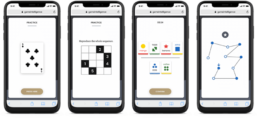
Examples of Capacio’s mobile-based tests.
Miran Tahir is a licensed psychologist and works to interpret and feed back the results of completed tests to make them useful, both for the individual as a coach or scout with a focus on getting everyone involved to understand the results in a way that makes them useful for the business.
“What Capacio’s tests measure are the executive abilities that govern our decision-making and behavior. Our ability to understand and control our executive abilities becomes especially important when there are rapidly changing conditions, when we need to handle large amounts of information and quickly relate to it in order to be able to make decisions quickly,” explains Miran.
What Miran describes is basically the constant prevailing situation on a soccer field.
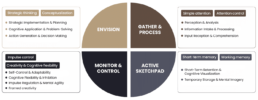
In short, the model is about our ability to collect information through, for example, attention, to keep the information up-to-date and active via our memory functions, to control our reactions and perform conscious actions through, for example, impulse control and then create a solution to the problem with the help of our creative ability, cognitive flexibility to find new solutions to finally use our strategic ability to find the most effective way to implement the solution.
To make this a little more concrete, PlaymakerAI’s employee Louise Schillgard, with a long and successful soccer career including in the national team and Liverpool, has done the tests.
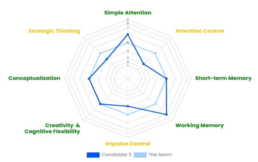
The results from Capacio’s tests are presented in a so-called spider diagram which then forms the basis for interpreting the player’s profile based on where the strengths lie, where the challenges lie, how to optimize the player’s performance and how to compensate for the difficulties.
Louise’s profile shows an overall smooth profile with some abilities that stand out as strengths, such as working memory and the ability to maintain attention and a few challenges such as the ability to maintain attention in the face of distractions along with strategic thinking and impulse control that are slightly lower. Just a slightly lower impulse control can be an advantage for a soccer player, as a high control can delay the reaction to shoot by a few milliseconds, which can decide a match. The test indicates the prerequisites for having a good eye for the game and being able to read the game.
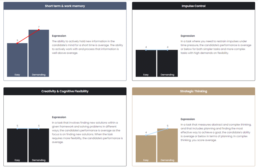
The tests also show how well the abilities work under pressure. In Louise’s case, it is clear that they work well under pressure and even increase in pressured situations.
Just as performance tests can give an indication of how, for example, a tall player will perform in the air, the tests give an indication of why a player performs in a certain way and can then help both players and coaches to maximize their potential, for example by playing in the right position or in the right player constellation.
“I recognize myself well in the results from the tests, but many of these insights came much later in my career. I’m surprised that so much of my profile can be read out in the short test time, which says a lot about how much insight you can get with Capacio’s tests,” says Louise Schillgard, “and if I could have gotten these insights earlier in my career could I have optimized my player performance even more.
The fact that PlaymakerAI can now supplement its existing analyzes with neurocognition tests means that it is possible to both predict and improve the understanding of the player’s performance, which creates a completely unique analytical ability in football through Multifaceted Analysis (MFA). The analysis enables profiling of entire teams as well as pointed individual profiling that improves the understanding and prediction of performance. Actors in the football world thus get a sharper tool to understand what lies behind ability and successful behavior and with the help of these tools they can optimize and adapt tactics, training and recruitment.
For coaches, this means an opportunity for more individually tailored coaching as well as matching and development of both the player and the team. The combination of data means an opportunity to better understand what natural strengths and weaknesses a player has and how they relate to each role on the field. Finally, it means for players in the team an opportunity to see and understand the strengths and weaknesses of their fellow players and thereby optimize the interaction.
For sports managers, this collaboration means an opportunity to improve the understanding of a player’s strengths and potential, which strengthens the ability to maximize a player’s performance and thus the team’s.
“Together with Capacio, we can co-analyze football data and cognition and thereby create unique and even sharper predictive indexes for our customers. In the same way that a player’s physical conditions affect their performance and development, the cognitive conditions do the same, but this has been overlooked in the past. Identifying strengths and weaknesses in such a concrete way allows you to shape player development around complementing and optimizing strengths. This is the future of analysis and we look forward to developing football together,” says Alexander Jorge, Head of Data at PlaymakerAI.
Multifaceted Analysis (MFA) is the future of football analysis. It provides data, insights, and analyses that allow you as a player or coach to get an additional percentage of a player’s full potential, both in the short term but also in the long-term development and provide a broader analysis basis for player development. It can make a big difference to a player or a team’s success.
Do you want to know more about how, using the analysis of the combination of football data and cognitive player data, you can obtain unique football insights? Contact Us!
About PlaymakerAI
Since its start in 2016, PlaymakerAI has driven the development of soccer analysis forward and has helped develop several of the metrics that have come to be accepted to better measure performance.
About Capacio
Capacio is a Swedish company founded i.a. by researchers in cognitive science who were responsible for world-leading research through studies of cognitive functions on soccer players and were the first in the world to demonstrate the power and precision of evidence-based cognitive tests to understand capacity, talent, and potential.
Ny fotbollstjänst ger spelare och tränare unik kunskap för att maximera spelarpotentialen.
Hur kan vi med hjälp av tester baserade på världsledande forskning hjälpa tränare att förbättra en spelares utveckling, stärka laguttagningen och öka träffsäkerheten i värvningar? Genom att kombinera neurokognitiva tester utvecklade av Capacio med sina befintliga prestationstester, lanserar nu PlaymakerAI en ny produkt – Multifaceted Analysis (MFA) som ger en djupare kunskap kring en spelares utvecklingspotential.
Det faktum att det finns 360 miljoner aktiva fotbollsspelare borde göra det intressant att förstå vad som gör en fotbollsspelare framgångsrik på planen. Mycket har analyserats kring en fotbollsspelares fysiska förmåga men psykets roll finns det mindre kunskap kring. Predrag Petrovic är specialistläkare i psykiatri, docent inom kognitiv neurovetenskap vid Karolinska institutet och medgrundare till Capacio. I snart 15 års tid så har Predrag forskat på kognition hos fotbollsspelare och han har bl a testat de spanska världsspelarna Iniesta och Xavi.
Neurokognitionsvetenskapen fokuserar på de exekutiva funktionerna i hjärnan som reglerar planering och genomförande av handlingar samt för målstyrd hantering av problem och uppgifter som vi ställs inför. Trycket på våra exekutiva förmågor ökar kraftigt när vi behöver lösa problem i en miljö där saker förändras snabbt och komplexa problem som kräver planering och kreativitet. Precis den typ av situationer som en fotbollsspelare ständigt ställs inför.
En starkt bidragande orsak till att kognitionstester inte använts ännu i en större utsträckning är att de tidigare har genomförts manuellt och krävt närvaro av en psykolog. Capacio har tagit expertkunskapen kring de kliniska testerna och byggt en digital lösning där testerna utförs på egen hand och där resultatet finns att tillgå direkt efter genomfört test. Därmed skapas möjlighet att kunna genomföra dessa tester på ett enklare sätt och till en rimlig kostnad och tidsinsats. Testerna delar upp de olika exekutiva förmågorna och kan mäta dessa och skapa en profil för en individs förmågor.
Exempel på de mobilbaserade testerna från Capacio.
Miran Tahir är legitimerad psykolog och arbetar med att tolka och återkoppla resultatet av genomförda tester för att göra det användbart, både för individen som tränare eller scout med fokus på att få alla involverade att förstå resultatet på ett sätt så att det blir användbart för verksamheten.
”Det Capacios tester mäter är alltså de exekutiva förmågor som styr vårt beslutsfattande och beteende. Vår förmåga att förstå och styra våra exekutiva förmågor blir extra viktig när det råder snabbt förändrade förutsättningar, när vi behöver hantera stora mängder information och snabbt förhålla oss till den för att snabbt kunna ta beslut”, förklarar Miran.
Det Miran beskriver är i princip den konstant rådande situationen på en fotbollsplan.
I korthet så handlar modellen om vår förmåga att samla in information genom t ex uppmärksamhet, att hålla informationen uppdaterad och aktiv via våra minnesfunktioner, att kontrollera våra reaktioner och utföra medvetna handlingar genom t ex impulskontroll och därefter skapa lösning på problemet med hjälp av vår kreativa förmåga, kognitiva flexibilitet att hitta nya lösningar för att slutligen nyttja vår strategiska förmåga för att hitta det mest effektiva sättet att genomföra lösningen.
För att göra detta lite mer konkret så har PlaymakerAI:s medarbetare Louise Schillgard, med en lång och framgångsrik fotbollskarriär bl a i landslaget och Liverpool, gjort testerna.
Resultatet från Capacio’s tester presenteras i ett s.k. spindeldiagram som sedan ligger till grund för att tolka spelarens profil utifrån var ligger styrkorna, var ligger utmaningarna, hur kan man optimera spelarens prestation och hur kan man kompensera för svårigheterna.
Louise profil visar över lag en jämn profil med några förmågor som sticker ut som styrkor, till exempel arbetsminnet och förmågan att hålla uppmärksamhet och ett par utmaningar som t ex förmågan att bibehålla uppmärksamheten när det uppstår distraktioner tillsammans med strategiskt tänkande och impulskontroll som ligger något lägre. Just en något lägre impulskontroll kan dock vara en fördel för en fotbollsspelare då en hög kontroll kan fördröja reaktionen att skjuta med några millisekunder, vilket kan avgöra en match. Testet indikerar förutsättningar att ha en bra blick för spelet och kunna läsa av spelet.
Testerna visar även hur väl förmågorna fungerar under press. I Louise fall är det tydligt att de fungerar väl under press och till och med ökar i pressade situationer.
Precis som prestationstester kan ge en indikation på hur t ex en lång spelare kommer att prestera i luften så ger testerna en indikation kring varför en spelare presterar på ett visst sätt och kan då hjälpa både spelare och tränare att maximera sin potential, t ex genom att spela på rätt position eller i rätt spelarkonstellation.
”Jag känner igen mig väl i resultatet från testerna men många av dessa insikter kom långt senare i karriären. Jag är förvånad att det går att utläsa så mycket av min profil på den korta testtiden, vilket säger mycket om hur mycket insikt man kan få med Capacios tester”, säger Louise Schillgard, ” och hade jag kunnat få dessa insikter tidigare i min karriär så hade jag kunnat optimera min spelarprestation ännu mer.
Att PlaymakerAI nu kan komplettera sina befintliga anaylser med neurokognitionstester gör att det går att både förutsätta och förbättra förståelsen av spelarens prestationsförmåga, vilket skapar en helt unik analysförmåga inom fotboll genom Multifaceted Analysis (MFA). Analysen möjliggör profilering av hela lag samt spetsig individuell profilering som förbättrar förståelsen och prediceringen av prestation.
Aktörer i fotbollsvärlden får därmed ett skarpare verktyg att förstå vad som ligger bakom förmåga och framgångsrikt beteende och med hjälp av dessa verktyg kan de optimera och anpassa taktik, träning och rekrytering.
För tränare innebär det en möjlighet till mer individanpassad coachning samt matchning och utveckling av såväl spelaren som laget. Kombinationen av data innebär en möjlighet att bättre förstå vilka naturliga styrkor och svagheter en spelare har och hur de förhåller sig till respektive roll på plan. Slutligen innebär det för spelare i laget en möjlighet att se och förstå sina medspelares styrkor och svagheter och härigenom optimera samspelet.
För sportchefer innebär detta samarbete en möjlighet att förbättra förståelsen av en spelares styrkor och potential, vilket stärker förmågan att maximera en spelares prestation och således lagets.
”Tillsammans med Capacio kan vi samanalysera fotbollsdata och kognition och därigenom skapa unika och ännu skarpare prediktiva index åt våra kunder. På samma sätt som en spelares fysiska förutsättningar påverkar deras prestation och utveckling gör de kognitiva förutsättningarna samma, men det har förbisetts tidigare. Att på ett så pass konkret sätt identifiera styrkor och svagheter gör att man kan forma spelarutveckling runt komplettering och optimering av styrkor. Detta är framtiden av analys och vi ser fram emot att tillsammans utveckla fotbollen”, säger Alexander Jorge, Head of Data på PlaymakerAI.
Multifaceted Analysis (MFA) är framtiden inom fotbollsanalys. Den ger data, insikter och analyser som gör att man som spelare eller tränare kan få ut ytterligare procent av en spelares fulla potential, både på kort sikt men även i den långsiktiga utvecklingen och ge ett bredare analysunderlag för att spelarutvecklingen. Det kan göra stor skillnad för en spelare eller ett lags framgång.
Vill du veta mer om hur du med hjälp av analys av kombinationen av fotbollsdata och kognitiva spelardata kan erhålla unika fotbollsinsikter? Kontakta oss!
Om PlaymakerAI
PlaymakerAI har sedan sin start 2016 drivit utvecklingen av fotbollsanalys framåt och varit med och utvecklat flera av de mått som kommit att bli vedertagna för att bättre mäta prestation.
Om Capacio
Capacio är ett svenskt företag grundat bl.a. av forskare inom kognitionsvetenskap som stått för världsledande forskning genom studier av kognitiva funktioner på fotbollsspelare och var först i världen med att visa på kraften och precisionen i evidensbaserade kognitiva tester för att förstå kapacitet, talang och potential.

Vad gör en fotbollsspelare framgångsrik?
Datum: 22 november 2023
Tid: kl 12.15-13.00.
Vad gör en fotbollsspelare framgångsrik på planen?
Hur kan neurokognitiva tester i kombination med prestationsanalys skapa rätt förutsättningar för spelare att nå den fulla potentialen fotbollsmässigt. PlaymakerAI bjuder tillsammans med vår samarbetspartner Capacio in till ett webinar om hur avancerad hjärnforskning kan hjälpa spelare att nå sin fulla potential. Du kommer också få en presentation av vår nya produkt – som kombinerar neurokognitiva tester med prestationsmätningar.
Anmäl dig idag (begränsat antal platser)
Unlock the Power of Brain-Based (Self)Leadership
Embark on a transformative journey with our online course, “Brain-Based (Self)Leadership”. Commencing on November 22, this course is your gateway to enhancing self-leadership, a cornerstone of effective leadership.
In today’s dynamic working environment and society, the demand for superior self-awareness has never been more critical. Your brain, the command center of your actions and decisions, plays a pivotal role in self-leadership. Understanding your brain is the key to unlocking your full potential.
This course offers a unique opportunity to delve deep into the inner workings of your brain and gain insights into how it impacts your actions, decisions, and interactions. The knowledge you acquire can be applied both in your personal and professional life, enabling you to make more informed choices and adapt effectively to various circumstances.
Over six weeks, you will immerse yourself in the cutting-edge realms of modern brain research and behavioral science. Learn directly from world-renowned experts, gaining a profound understanding of your own cognitive profile and how it influences your behavior.
As a bonus, our course includes a comprehensive profiling test, which maps your unique cognitive profile. This invaluable tool will serve as a foundation for your ongoing learning and exploration, empowering you to thrive in both your personal and professional spheres.
By enrolling in “Brain-Based (Self)Leadership,” you are investing in your future. Expect enhanced leadership skills, increased workplace success, stronger relationships and collaborations, and an overall boost to your balance and well-being in life.
Don’t miss this opportunity to take your leadership to new heights.
Join us on November 22 and embark on your journey to brain-based self-leadership. Your brain, your guide!

Capacio, one of the Life Science Inspirators at Lindholmen Open Day

Capacio is excited to announce our participation in the annual Lindholmen Open Day event, where we will be discussing how to “Unlock People’s Potential with Data Analytics and Brain Science” alongside our esteemed business partner, Sigma Technology. This event, hosted at Lindholmen Science Park in Gothenburg, is a unique opportunity to explore the innovative and collaborative initiatives flourishing within the Science Park’s vibrant community.
Innovative Power for Sweden
This year’s theme, “Innovative Power for Sweden,” perfectly encapsulates the groundbreaking work we have undertaken in collaboration with Sigma Technology this spring. Our project was selected as one of the participants in this year’s edition of the SAS Institute’s global Hackathon, where we set out with a mission to digitize the psychological process. This journey encompasses every stage from measurement and profiling to feedback and practical application.
At the core of our endeavor is the application of advanced data analysis and visualization techniques to the realms of cognitive neuroscience and evidence-based measurement tools. Capacio’s primary aim is to foster a profound understanding of how individuals dynamically function, tapping into their hitherto invisible, innate abilities, talents, and potential.
Performance Profiles
Our broader objective is to craft easily comprehensible and invaluable behavior and performance profiles. These profiles will serve as powerful tools for companies, organizations, and recruiters, facilitating the identification of the perfect match for various roles. This transformative process ensures precision in team building, collaboration, and leadership, aligning the right individuals with the right positions under the optimal conditions.
Our partnership with the advanced analytics team has yielded remarkable results, enabling us to extract predictable behaviors from the data.
Join us at Lindholmen Day
If you’re eager to learn more about our exciting work and witness the intersection of data analytics and brain science in action, we invite you to join us at the Lindholmen Open Day. For detailed information on the event and how to attend, please visit the following link: Lindholmen Open Day Event Details.
About Lindholmen Science Park:
Lindholmen Science Park is not just a dynamic area but also a collaborative platform without geographical boundaries. It serves as the driving force behind numerous cutting-edge development projects in Sweden, with a particular focus on shaping the future of mobility. Lindholmen Science Park AB is collectively owned by Chalmers University of Technology, the City of Gothenburg, and the business community. Over the past 20 years, these stakeholders have invested extensively and purposefully, nurturing a modern and inspiring innovation environment that supports some of Sweden’s most significant development projects.

The Paradigm Shift - Due diligence with the NeuroCognitive Performance Tests

As an investor, would you invest in an A-team with a B-idea? Or a B-team with an A-idea? Most investors would undoubtedly answer A-team. But how do you identify them?
In your investment due diligence, you want to do due diligence not just on the company, the business plan, and the technology but also on the founders and the founding team. However, the diligence process for founders has room for improvement.
Here, we’ll explore the factors contributing to this failure and demonstrate how contemporary neuroscience can aid investors in identifying and cultivating self-reflective entrepreneurs with a growth mentality, using the NeuroCognitive Performance Test as due diligence for founders.
Due Diligence of founders = understanding of the individual
In selection procedures, the essence lies in comprehending individuals’ thought processes, behavior, and performance in diverse situations. Investors frequently face lofty expectations, limited conditions, and a constantly changing environment when assessing founders and teams. These factors collectively contribute to the investment decision being particularly demanding.
Evaluation processes fail – drastically!
Let’s look at recruitment as a benchmark for the founder’s diligence.
Research indicates that about 50 % of new hires fail within 18 months (Harvard Business Review). Add to that, that only 19 % of new employees achieve unequivocal success (according to Leadership IQ). The challenge is enormous. Gallup shows that companies miss the mark on high managerial talent in 82% of their hiring decisions and that managers account for 70% of the variance in employee engagement. And up to date, the test used is the traditional psychological test in recruitment.
As founders also are leaders, this tells us something about the challenge of founder diligence. It is hard to predict behavior and performance!
Why do HR diligence processes fail?
Understanding and predicting people’s behavior and performance is challenging. And more so than ever in a fast and ever-changing world, where increasing flexibility and adaption are required. Today’s diligence process is biased due to the not sharp enough tools, meaning we must rely on past performance and subjective judgment in evaluations, whether in recruitment or investments. The result? The above facts show a biased process with a staggering 50 % – 20 % hit rate.
There are clear challenges with current tests
Psychological testing is the best there is to assess behavior, and traditional tests are what is available on the market. But there are clear challenges. Today, evaluation processes use personality tests, logic tests, and frameworks that only partially capture a person’s inherent capacity and potential to develop. The problem with traditional tests is that they only give partial answers. In the absence of sharper and complementary tests, there is a tendency among users to overinterpret these results or to use them in a biased way. Let´s examine the major challenges:
- There is a general lack of knowledge and interest among the users. This opens for misuse and misinterpretations. And leads to a utilization rate that is too low.
- There is a plethora of suppliers using excessive marketing and unrealistic promises. This fact marries poorly with a lack of understanding.
- There is a clear lack of relevance in the traditional measurements – The need is to understand how individuals function, but current tests measure how individuals function on a group level, which is not necessarily the same as a specific individual. Thus, there remains the need to measure and explain functioning on an individual level with stronger evidence.
- Traditional tests consist of static, unspecific, and insensitive metrics – Current measures tell us something about observable behavior and a limited number of traits on a high level. In normal situations, when things don’t change. It is a start and gives a hint, but it is a poor representation of reality.
The need is to complement these with more specific and sensitive metrics on an individual level and capture the dynamics inside and outside the individual. And that is sensitive and can shed light on the constant changes in behavior due to this dynamic. Then, we can start to understand actual behavior.
The overall result of the above is decisions that are based on partial, sometimes incorrect data and thus tend to be highly subjective and biased, exactly what can be seen in global studies on the topic
Personality and logic tests – a start but by no means enough.
Personality tests are questionnaires capturing an individual’s view of themselves. Globally, there are over 2,500 different personality tests. The predictive validity is low, even when using the most researched model or framework, the Big Five because it is subjective and meant to understand groups of people rather than individuals.
Logic tests, aptitude or problem-solving tests, are a small part of larger IQ batteries. State of the art is WAIS-IV from Pearson. Intelligence tests are cognitive tests developed to assess people’s ability to perform in academic studies. They measure the ability to “solve the same types of specific problems in a non-changing environment.” That is not the reality of today, where constant change is a fact.
Paradigm shift: Cognitive Neuroscience in the service of investors and optimized talent management
Cognitive Neuroscience developed as a branch of research due to the existing psychological assessments, i.e., often used in today’s evaluation of founders and candidates, were insufficient to explain behavior and function.
The one simple explanation is that the brain is central to understanding behavior, and the tools to assess brain function and information processing in relation to behavior still need to be developed.
Since the start, and especially in the last 30 years, development in Cognitive Neuroscience has sky-rocketed but, oddly enough, remained in academies and psychiatric clinics as very sharp tools to understand how people think, adapt, create, decide, solve problems, and act. From there, make more precise analyses and decisions on best supporting patients with challenges to optimize their lives and functioning.
Now, these tools have been validated and proven to work in the market of Talent Management, focusing on contexts of “functioning,” i.e., not to detect challenges but also strengths, capacity, and potential.
The NeuroCognitive Performance Tests are used to judge who is optimal for different assignments or roles. And how to support and develop individuals, leaders, and teams to function and perform optimally. Perfect for investors, leaders, and HR.

Sharper Due Diligence of Founders before Investing

Deep Level Evaluation of the Founder’s executive abilities before investing
Evaluating founders and the management teams is crucial in the Due Diligence process. Most investors agree that the driving force behind a company’s success lies in the strength and abilities of the founding team.
NeuroCognitive Performance test adds crucial insights when evaluating founders
To understand if a founder has what it takes to succeed across different tasks and contexts, you must assess their executive capacity with NeuroCognitive Performance Tests, which means understanding the executive functioning of the individual.
The Digital assessments based on Cognitive Neuroscience are the missing piece in evaluating founders, teams, talents, and any activity involving people or organizations.
How do VC and investors perform Due Diligence of Founders?
Top VC funds/companies have different methods and strategies for assessing the founders. The evaluation is often a mix of observations, interviews, and traditional psychological tests. Some more advanced VCs work with organizational psychologists.
Why traditional psychological test lack precision?
Traditional psychological testing is mainly built upon personality questionnaires and logic tests. Capturing an individual’s subjective view of herself. And a small part of cognition testing the ability to solve one kind of problem in an unchanged environment. Research shows that traditional tests have a measurement precision of about 20 – 50%. Read the latest meta study on validity in personnel selection by Sackett, P. R., Zhang, C., Berry, C. M., & Lievens, F. (2021).


Improve your predictive power of individuals and teams.
Enhance your insights and predictive power by combining your current methods of evaluating founders with Cognitive Neuroscience. It gives a sharper, more precise base for insights into the due diligence process. It will give you a 30 % higher precision than with current assessments.
Cognitive Neuroscience is how the brain’s information processing generates thoughts, feelings, and a basis for decision-making.
This decides how people perform and function in specific tasks and environments. NeuroCognitive Performance tests has a precision of 70% – 90% in measuring cognitive capacity, according to multiple studies over time. (MSU, Bird et al 2003, Williams et al 2005, Lemay et al 2010, Wechsler 2008)
Capacio Talent
Retooling the missing piece in the Due Diligence process

The First NeuroCognitive Performance Test for investors and VC funds.
Capacio’s digital assessment measure the capacity of crucial cognitive abilities introducing time pressure and complexity levels in various tasks and problems that constantly change. Just like reality. They also tell us about the performance patterns in various day-to-day activities.
Capacio is an evidence-based brain assessment with data-driven AI tools and backed by leading cognitive and behavioral experts. The HR teams at HM, Volvo, and Klarna use it to help them more precisely understand the capabilities, talents, and potential of their candidates and employees.
Capacio Talent´s Features
Mobile NeuroCognitive performance tests
Finish the eight test in either a single 45-minute session or four separate 10-minute rounds.
Individual playlist for self development
A full profile report includes all available results. Personalized video tutorial for both user and candidate
User-Friendly Assessment Portal
Dashboard – Aggregated view of all tested individuals, Easy to sort, filter and match. Easy to share reports.
Enhanced Personality++ Test
Easier to interpret. Includes empathy, social style, impulsivity and emotional regulation.
Free trial
Anyone can sign up and try the tool. Book a time with our customer success to walk through the tool and the result.
SaaS Plattform
Faster and easier to use than ever before. Select assissments based on your needs. Flexible price model.
Expert Advisory
People are dynamic and complex. An expert adds several layers of information and facilitates decision making.
Coming Up
A Cognitive Team Application
Adding unique and valuable insights into team functioning. In terms of cognition, behavior and performance. Strengths and weaknesses in relation to targets and challenges. Awareness of oneself and other’s ability and capacity and much more. Keep an eye out and give us a call if you want to be an early adopter.

The Cognitive Tribe
A podcast initiative by Capacio
“The Cognitive Tribe” is the brainchild of Capacio CEO & co-founder Anders Norén, and former school leader of the year, Hans Jakobsson. The idea is to explore the power of cognition in an informative, fun, and personal way by talking to leading experts in the area as well as interesting people with a brain and an interest in cognition.. Our motto is “Without our brains, we are just a piece of meat.”


