

As an investor, would you invest in an A-team with a B-idea? Or a B-team with an A-idea? Most investors would undoubtedly answer A-team. But how do you identify them?
In your investment due diligence, you want to do due diligence not just on the company, the business plan, and the technology but also on the founders and the founding team. However, the diligence process for founders has room for improvement.
Here, we’ll explore the factors contributing to this failure and demonstrate how contemporary neuroscience can aid investors in identifying and cultivating self-reflective entrepreneurs with a growth mentality, using the NeuroCognitive Performance Test as due diligence for founders.
Due Diligence of founders = understanding of the individual
In selection procedures, the essence lies in comprehending individuals’ thought processes, behavior, and performance in diverse situations. Investors frequently face lofty expectations, limited conditions, and a constantly changing environment when assessing founders and teams. These factors collectively contribute to the investment decision being particularly demanding.
Evaluation processes fail – drastically!
Let’s look at recruitment as a benchmark for the founder’s diligence.
Research indicates that about 50 % of new hires fail within 18 months (Harvard Business Review). Add to that, that only 19 % of new employees achieve unequivocal success (according to Leadership IQ). The challenge is enormous. Gallup shows that companies miss the mark on high managerial talent in 82% of their hiring decisions and that managers account for 70% of the variance in employee engagement. And up to date, the test used is the traditional psychological test in recruitment.
As founders also are leaders, this tells us something about the challenge of founder diligence. It is hard to predict behavior and performance!
Why do HR diligence processes fail?
Understanding and predicting people’s behavior and performance is challenging. And more so than ever in a fast and ever-changing world, where increasing flexibility and adaption are required. Today’s diligence process is biased due to the not sharp enough tools, meaning we must rely on past performance and subjective judgment in evaluations, whether in recruitment or investments. The result? The above facts show a biased process with a staggering 50 % – 20 % hit rate.
There are clear challenges with current tests
Psychological testing is the best there is to assess behavior, and traditional tests are what is available on the market. But there are clear challenges. Today, evaluation processes use personality tests, logic tests, and frameworks that only partially capture a person’s inherent capacity and potential to develop. The problem with traditional tests is that they only give partial answers. In the absence of sharper and complementary tests, there is a tendency among users to overinterpret these results or to use them in a biased way. Let´s examine the major challenges:
- There is a general lack of knowledge and interest among the users. This opens for misuse and misinterpretations. And leads to a utilization rate that is too low.
- There is a plethora of suppliers using excessive marketing and unrealistic promises. This fact marries poorly with a lack of understanding.
- There is a clear lack of relevance in the traditional measurements – The need is to understand how individuals function, but current tests measure how individuals function on a group level, which is not necessarily the same as a specific individual. Thus, there remains the need to measure and explain functioning on an individual level with stronger evidence.
- Traditional tests consist of static, unspecific, and insensitive metrics – Current measures tell us something about observable behavior and a limited number of traits on a high level. In normal situations, when things don’t change. It is a start and gives a hint, but it is a poor representation of reality.
The need is to complement these with more specific and sensitive metrics on an individual level and capture the dynamics inside and outside the individual. And that is sensitive and can shed light on the constant changes in behavior due to this dynamic. Then, we can start to understand actual behavior.
The overall result of the above is decisions that are based on partial, sometimes incorrect data and thus tend to be highly subjective and biased, exactly what can be seen in global studies on the topic
Personality and logic tests – a start but by no means enough.
Personality tests are questionnaires capturing an individual’s view of themselves. Globally, there are over 2,500 different personality tests. The predictive validity is low, even when using the most researched model or framework, the Big Five because it is subjective and meant to understand groups of people rather than individuals.
Logic tests, aptitude or problem-solving tests, are a small part of larger IQ batteries. State of the art is WAIS-IV from Pearson. Intelligence tests are cognitive tests developed to assess people’s ability to perform in academic studies. They measure the ability to “solve the same types of specific problems in a non-changing environment.” That is not the reality of today, where constant change is a fact.
Paradigm shift: Cognitive Neuroscience in the service of investors and optimized talent management
Cognitive Neuroscience developed as a branch of research due to the existing psychological assessments, i.e., often used in today’s evaluation of founders and candidates, were insufficient to explain behavior and function.
The one simple explanation is that the brain is central to understanding behavior, and the tools to assess brain function and information processing in relation to behavior still need to be developed.
Since the start, and especially in the last 30 years, development in Cognitive Neuroscience has sky-rocketed but, oddly enough, remained in academies and psychiatric clinics as very sharp tools to understand how people think, adapt, create, decide, solve problems, and act. From there, make more precise analyses and decisions on best supporting patients with challenges to optimize their lives and functioning.
Now, these tools have been validated and proven to work in the market of Talent Management, focusing on contexts of “functioning,” i.e., not to detect challenges but also strengths, capacity, and potential.
The NeuroCognitive Performance Tests are used to judge who is optimal for different assignments or roles. And how to support and develop individuals, leaders, and teams to function and perform optimally. Perfect for investors, leaders, and HR.
Related Blogs
Breakthrough for Capacio Method in Swedish Elite Football
Elite football enters a new performance frontier: cognition and decision-making

Daniel Setterwall Joins Capacio
Daniel Setterwall joins Capacio with a primary focus on the company’s ongoing fundraising process
Elite Footballers’ Cognitive Abilities Featured in Major Swedish Newspaper
Swedish researchers uncover striking differences in brain function and personality traits among elite football players

Fotbollsspelare – Mästarna på Problemlösning?
Ny forskning visar att fotbollsspelare inte bara utmärker sig på planen utan även i problemlösning
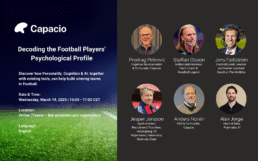
Join our exclusive webinar – Decoding the Football Players’ Psychological Profile
Discover how Personality, Cognition & AI, together with existing tools, can help build winning teams in Football.
Capacio’s co-founder Predrag Petrovic interviewed by Sveriges Radio about the role Cognitive abilities play in Football
Capacio's co-founder, Associate Professor, Senior Physician and psychiatrist Predrag Petrovic, was interviewed on Radiosporten,…

Measuring the Mind – The Future of Team Building in Sports
What if recruiting and coaching elite athletes wasn’t just about physical performance and match stats—but also about cognitive…

New International Study confirms that Elite Football Players are Disciplined, Quick Thinkers, Adaptable, and Resolute
What our study reveals is that elite football players exhibit remarkably higher cognitive abilities compared to the general…
Så skapade vi ett kognitivt lyft för Hammarby Handboll – ta del av metoder och resultat!
Capacio har testat och profilerat Hammarby A och Hammarby juniorlag. Resultaten har återkopplats till Coach och sportchef samt till…

Staffan Olsson Aims to Revolutionize Team Performance with Capacio’s Groundbreaking Executive Functioning Tests
In the fiercely competitive realm of sports, marginal gains often determine victory.