

Elite football enters a new performance frontier: cognition and decision-making
As the first Swedish football club, IFK Göteborg has begun using the tech company Capacio’s method to measure and understand players’ cognitive functioning.
IFK Göteborg’s Sporting Director, Jesper Jansson, says:
“Previously, a lot of decisions were based on gut feeling, which is still important. But this allows us to work more systematically and reduce guesswork.”
He continues:
“This method adds a new dimension to recruitment. In the future, I believe this could become as natural as physical tests and medical screenings. It’s not about disqualifying anyone, but about getting to know the player better.”
Capacio CEO, Anders Norén, welcomes the fact that football has now opened the door to the company’s digitised psychological tests:
“This part of performance has long been a ‘black box’. Clubs have analysed physical metrics and data extensively, but not how players actually take in information and make decisions.”
Interest in the tests is growing, both in Sweden and internationally.
“We are in a breakthrough phase. IFK Göteborg is the first in Sweden to implement this fully, but they will not be alone for long. Prominent international actors are in the pipeline. This is a missing piece of the puzzle.”
A prominently featured article, Göteborgs-Posten highlights how elite football is now taking the next step beyond physical performance and traditional statistics—towards a deeper understanding of how players think, make decisions, and function in the complex environment that is elite football. The article describes how IFK Göteborg is working with cognitive and psychological profiling as a new complementary tool in elite football operations.
For decades, elite football has optimized physical performance to near perfection.
Sprint meters, GPS data, passing networks, and medical screenings are now standard practice.
Yet one crucial dimension has long remained underexplored:
how players think, process information, regulate themselves, and make decisions under pressure.
The article highlights how IFK Göteborg has begun working systematically with cognitive and psychological profiling as part of their elite operations. Rather than replacing experience, intuition, or football expertise, this approach adds a new layer of understanding—much like physical data once complemented traditional scouting.
What the article highlights
- Why physical and tactical data alone are not enough to explain performance
- The importance of cognitive functioning to understand decision-making, adaptability, and individual conditions
- Scouting, recruiting, coach and player perspectives on cognition
- How cognitive insights can support recruitment, development, and team building
- The importance of using such data responsibly—for dialogue and understanding, not judgment
A key takeaway is that this work is not about labelling players or reducing people to scores.
It is about gaining better context when making high-stakes decisions in an increasingly complex sport.
As competition intensifies and margins become smaller, understanding the human brain is emerging as a natural next step in performance development—alongside physical testing, medical screening, and tactical analysis.
The future of football is not only faster and stronger.
It is also smarter, more adaptive, and more human-aware.
Original article
The full article (in Swedish, behind a paywall) is published by Göteborgs-Posten:
“The new trend: Clubs are mapping players’ brains”
Access the full article
Fill in your details to get access to the full article.
We believe this represents a meaningful shift in how elite sport understands performance – and a necessary one.
Elitfotbollen kliver in i ett nytt prestationsområde: kognition och beslutsfattande
Som första svenska fotbollsklubb har IFK Göteborg börjat använda techföretaget Capacio’s metod för att mäta och förstå spelarnas kognitiva förmågor.
IFK Göteborgs sportchef Jesper Jansson säger:
”Tidigare har man gått mycket på magkänsla, vilket fortfarande är viktigt. Men det här gör att vi kan arbeta mer systematiskt, bättre förstå individuella förutsättningar och minskar gissningarna.”
Han fortsätter:
”Den här metoden tillför en ny dimension i värvningsarbetet. I framtiden tror jag att detta kan bli lika självklart som fystester och medicinska kontroller. Det handlar inte om att underkänna någon, utan om att lära känna spelaren bättre.”
Capacio vd Anders Norén välkomnar att fotbollen nu öppnat dörren till bolagets digitaliserade psykologiska tester:
”Den här delen av prestationen har länge varit en ‘black box’. Klubbarna har analyserat fysik och data i stora mängder, men inte hur spelare faktiskt tar in information, fattar beslut och anpassar sig.”
Intresset för testerna växer, både i Sverige och internationellt.
”Vi befinner oss i en genombrottsfas. IFK Göteborg är först i Sverige att genomföra detta fullt ut, men de kommer inte att vara ensamma länge. Internationella aktörer ligger i startgroparna. Det här är en pusselbit som har saknats.”
I en stort uppslagen artikel uppmärksammar Göteborgs-Posten hur elitfotbollen nu tar nästa steg bortom fysik och traditionell statistik – mot en djupare förståelse av hur spelare tänker, fattar beslut och fungerar i komplexa miljöer. Artikeln beskriver hur IFK Göteborg arbetar med kognitiv och psykologisk profilering som ett nytt verktyg i elitverksamheten.
Under decennier har elitfotbollen optimerat den fysiska prestationen till nästan perfektion.
Sprintmeter, GPS-data, passningsnätverk och medicinska screeningar är idag standard.
Ändå har en avgörande dimension länge varit underutforskad:
hur spelare tänker, bearbetar information, reglerar sig själva och fattar beslut under press.
I artikeln lyfter Göteborgs-Posten hur IFK Göteborg nu arbetar systematiskt med kognitiv och psykologisk profilering som en del av sin elitverksamhet. Metoden ersätter inte erfarenhet, intuition eller fotbollskunskap – utan tillför ett nytt lager av förståelse, på samma sätt som fysisk data en gång kompletterade traditionell scouting.
Vad artikeln belyser
- Varför fysiska och taktiska data inte räcker för att förklara prestation
- Hur kognitiv funktion påverkar beslutsfattande, anpassningsförmåga och individuella förutsättningar
- Användning för scouter, coacher och spelare
- Hur kognitiva insikter kan stödja rekrytering, utveckling och lagbygge
- Vikten av att använda denna typ av data ansvarsfullt – för dialog och förståelse, inte för att döma
En central slutsats är att arbetet inte handlar om att etikettera spelare eller reducera människor till siffror.
Det handlar om att skapa bättre beslutsunderlag i en allt mer komplex idrott.
När konkurrensen hårdnar och marginalerna minskar framstår förståelsen av den mänskliga hjärnan som ett naturligt nästa steg i prestationsutveckling – sida vid sida med fysisk testning, medicinska kontroller och taktisk analys.
Fotbollens framtid är inte bara snabbare och starkare.
Den är också smartare, mer anpassningsbar och mer medveten om människan bakom prestationen.
Originalartikel
Hela artikeln (på svenska, bakom betalvägg) publicerades i Göteborgs-Posten:
“Den nya trenden: klubbar kartlägger spelarnas hjärnor”
Få tillgång till hela artikeln
Fyll i dina kontaktuppgifter så skickar vi hela artikeln.
Vi menar att detta representerar ett viktigt skifte i hur elitidrotten förstår prestation – och ett nödvändigt sådant.
Related Blogs

Daniel Setterwall Joins Capacio
Daniel Setterwall joins Capacio with a primary focus on the company’s ongoing fundraising process
Elite Footballers’ Cognitive Abilities Featured in Major Swedish Newspaper
Swedish researchers uncover striking differences in brain function and personality traits among elite football players

Fotbollsspelare – Mästarna på Problemlösning?
Ny forskning visar att fotbollsspelare inte bara utmärker sig på planen utan även i problemlösning
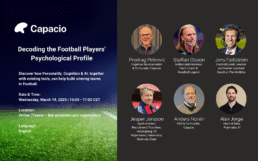
Join our exclusive webinar – Decoding the Football Players’ Psychological Profile
Discover how Personality, Cognition & AI, together with existing tools, can help build winning teams in Football.
Capacio’s co-founder Predrag Petrovic interviewed by Sveriges Radio about the role Cognitive abilities play in Football
Capacio's co-founder, Associate Professor, Senior Physician and psychiatrist Predrag Petrovic, was interviewed on Radiosporten,…

Measuring the Mind – The Future of Team Building in Sports
What if recruiting and coaching elite athletes wasn’t just about physical performance and match stats—but also about cognitive…

New International Study confirms that Elite Football Players are Disciplined, Quick Thinkers, Adaptable, and Resolute
What our study reveals is that elite football players exhibit remarkably higher cognitive abilities compared to the general…

Så skapade vi ett kognitivt lyft för Hammarby Handboll – ta del av metoder och resultat!
Capacio har testat och profilerat Hammarby A och Hammarby juniorlag. Resultaten har återkopplats till Coach och sportchef samt till…

Staffan Olsson Aims to Revolutionize Team Performance with Capacio’s Groundbreaking Executive Functioning Tests
In the fiercely competitive realm of sports, marginal gains often determine victory.
Capacio and PlaymakerAI develop unique football service
New Football Service Provides Players and Coaches with Unique Insights to Maximize Player Potential